
The technology you decide to use in a race can be the difference between winning and losing. At the moment, two of the most popular technologies that are available in the market are race bibs with chips and GPS tracking systems.
In this blog, we will talk about the differences, compare the performance, and help you decide which option is best for your next marathon.
What Are Race Bibs with Chips?
The use of race bibs with chips is part of the most widely used race timing technology. The chip, which is usually an RFID or similar technology, is placed on the back of the race bib that each participant wears. The mats that are placed at the start and finish lines, as well as at other points, interact with the chip to record the correct times as the participants cross these points.
How it works:
- Each runner has a unique bib number with a built-in timing chip.
- The chip is scanned by the antennas/readers in the timing mats as the runner crosses.
- The timing system is accurate to the thousandth of a second.
- The results are collated and published in real time.
This method has become the backbone of competitive marathon timing solutions because it provides accurate chip times for all runners.
What Is GPS Tracking?
GPS tracking involves the use of satellites and GPS devices worn on the wrist or attached to a bib to track the location and pace of a runner during a race. The devices are capable of offering information on distance, pace, and route.
How it works:
- Runners have a GPS-enabled device or use a race app with GPS functionality.
- The system constantly records the position of the runner.
- After the race, the data is processed to estimate total time and splits.
GPS tracking is widely used for training and recreational running because it provides pace and distance information without the need for infrastructure. It works in a different way from chip timing, though.
Race Bibs with Chips: The Industry Standard
How it works: Passive RFID chips embedded in bibs are activated as runners cross timing mats (start, splits, finish). Antenna arrays read multiple runners at once.
Accuracy: Chip timing achieves ±0.2 seconds accuracy (World Athletics standard) with 99.9% read rates verified at major marathons (Boston 99.97%, 34K runners)
- Capture exact crossing times at timing mats
- Eliminate human error
- Provide definitive official times for placement and awards
Main advantages:
- Official results: Gun time (mass start) + chip time (individual gun)
- Split timing: 10K/20K/half splits at multiple
- Video verification: Photo at every mat
- Proven scale: Boston, NYC, London marathons.
- Cost: $1.50-$3/runner (disposable bib tags).
Limitations
- No live tracking (results post-race)
- Mat crowding at splits
- Lost bibs means no timing insights
GPS Tracking: Real-Time Appeal, Accuracy Tradeoffs
They are of two types:
- Dedicated GPS devices (MyLaps): Shoe-mounted, ±
- Smartphone apps (Strava, Runkeeper): ±5-10m, signal loss
Accuracy: Research says that -1.2% distance error due to underestimation and it can be unreliable when crossing bridges, subways, or high-rise buildings.
Strengths
- Live tracking: The apps used by spectators display splits.
- Pacing data: Cadence, heart rate,etc.
- Trail/ultra suitability (no mats required)
Disadvantages
- Not official: Race organizers do not take GPS into account when determining rankings
- Battery drain is a major issue as 0%+ drain from high-frequency tracking
- Cost: $15-50 per runner (for devices)
Head-to-Head Comparison: Data-Driven Verdict
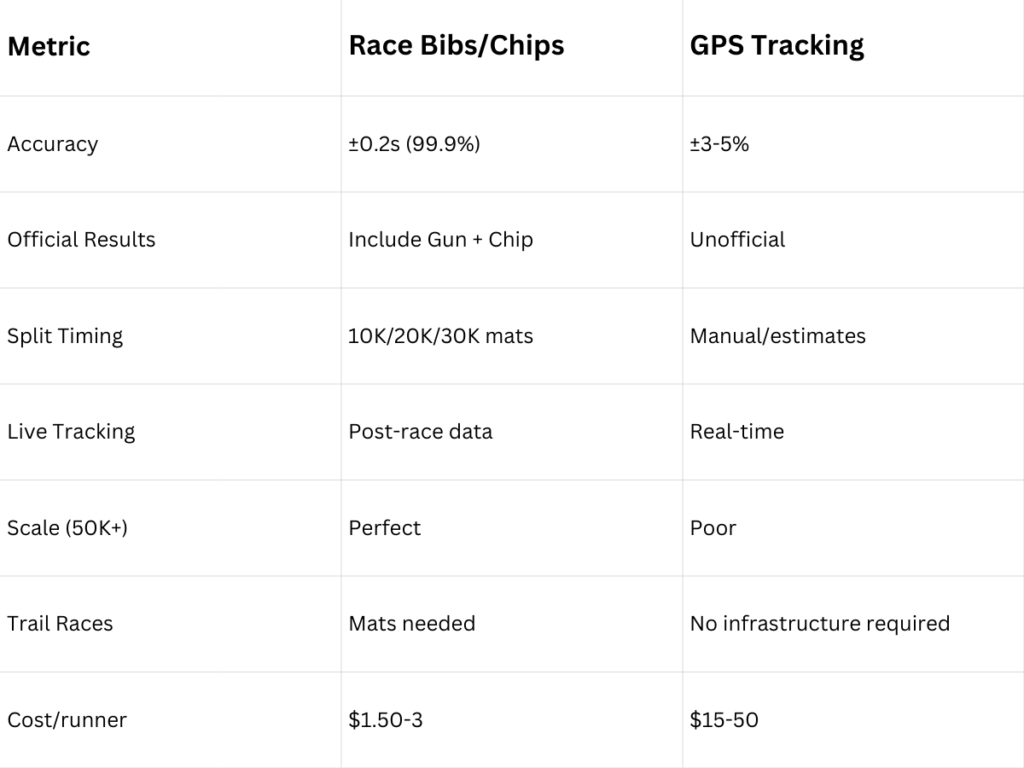
How do both systems perform during real events?
Crowd Density & Start Lines
Chip systems record times only when a runner crosses a timing mat, and thus the density of the crowd doesn’t matter.
The GPS tracking system may have problems when runners congregate, which may cause delays in the registration of signals or lead to location errors.
Environmental Factors
The race timing system with chips is weatherproof and does not depend on signal quality.
The GPS trackers may lose satellite signals under bridges, in areas with tree cover, or in urban “canyons.”
In bigger marathons involving thousands of participants and complicated routes, chips provide reliable performance irrespective of the number of people present at the start.
Real-Time Tracking & Spectator Experience
One of the reasons why GPS tracking has become popular is its capability of displaying real-time progress. Currently, most events incorporate both tracking systems:
- Race bibs with chips for official timing
- GPS tracking for spectator apps and progress maps.
Hybrid solutions enable viewers to track the progress of runners in real time, and at the same time, they can maintain the accuracy needed by marathon timing services.
Cost Factors & Scale of Event
Race Bibs With Chips
- Require timing equipment (mats, readers, software)
- Staff trained in setup and data processing
The cost is dependent on the size of the event but is viewed as a standard investment for official timing
GPS Tracking
- Lower initial investment in infrastructure, sometimes in the form of a mobile app
- Per-participant costs for GPS tracking can be substantial
- Not acceptable as official race timing without cross-verification from chip systems.
For bigger races, the cost of a full chip timing system is justified for its accuracy, reliability, and approval. For smaller fun runs, GPS alone may be sufficient, but there are also disadvantages to this.
Conclusion
When planning your next race timing solution, consider a hybrid approach to provide accuracy and interactivity.
For race organizers and running events that require accuracy, race bibs with chips remain the most optimal solution for marathon timing services, and GPS technology adds another level of engagement.

Ashish Saboo is the Co-Founder & CEO of YouJustRun, a technology-driven platform focused on building engaging, scalable experiences in the endurance sports and events ecosystem. A serial entrepreneur with strong operational depth, he has founded and led global ventures including Tech-Synergy, a KPO and technology services company, and brings hands-on experience in scaling products, teams, and markets. Leveraging his ecosystem exposure, Ashish is also associated with Startup Steroid, where he contributes to enabling startups through investor access and structured growth support.